Every time I start a new engagement, one of the first things I ask is: "How do you currently handle access reviews?"
The answer is almost always the same. A spreadsheet. A shared inbox. A quarterly email that goes out, gets ignored, and eventually gets marked complete by whoever sent it. Sometimes it's nothing at all — "we trust our managers to flag it."
That works until it doesn't. And when it stops working, the cost is real: a failed audit, a breach traced back to an ex-employee who still had access six months after they left, or an access review campaign that takes three weeks to run and still misses half the entitlements.
This is the problem Okta Identity Governance was built to solve. And what I find interesting about it is that it doesn't solve it the same way for everyone — it scales with where you are as a company.
What Okta Identity Governance Actually Is
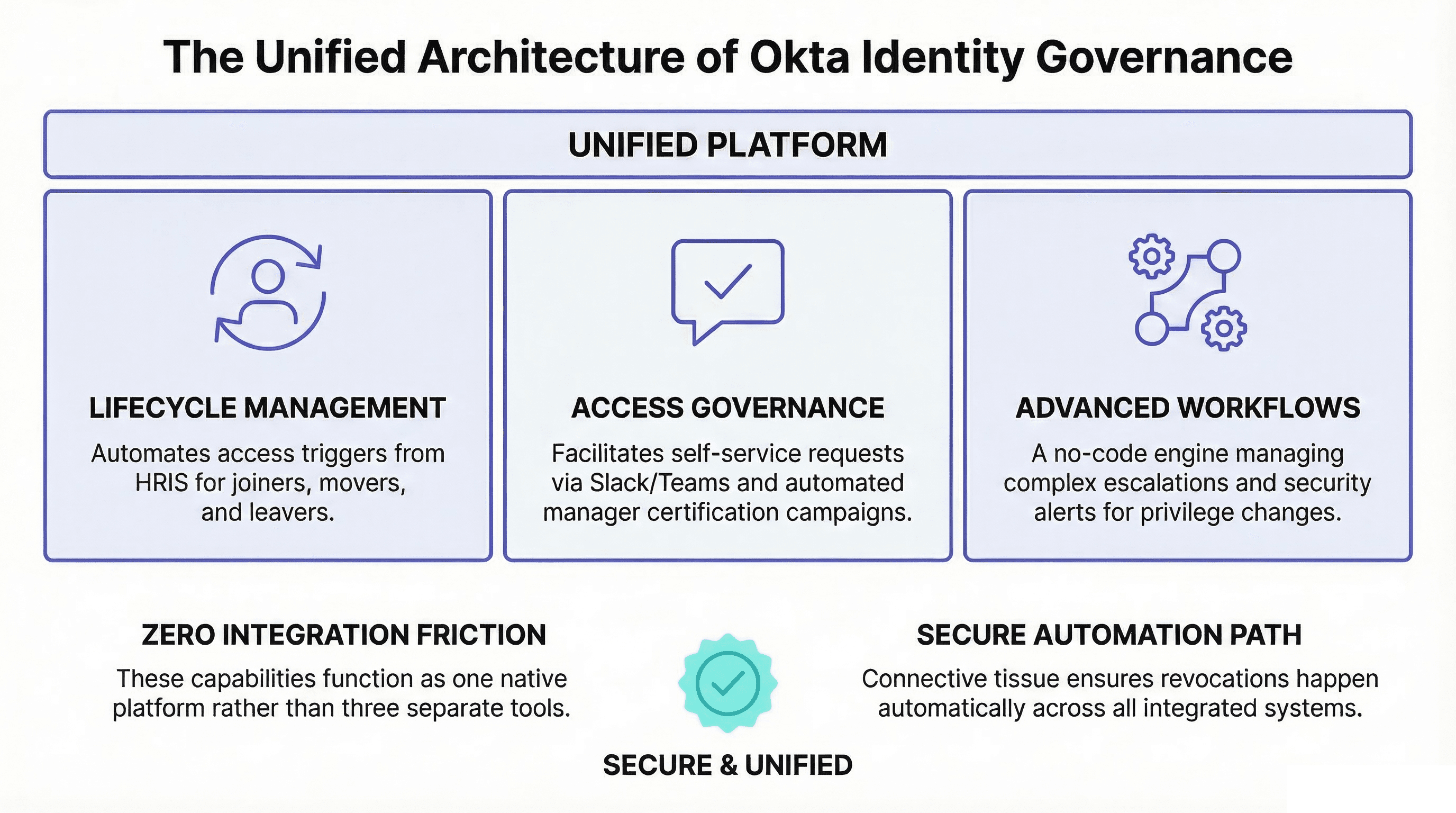
Okta Identity Governance (OIG) is a separately licensed add-on to your existing Okta Workforce Identity subscription — an SKU you enable on top of what you already have. It's built natively into the same platform, sharing the same identity data, user profiles, and policy engine. No separate sync, no secondary system to maintain. It adds three capabilities that work together:
Lifecycle Management — automates how users get access when they join, what changes when they move roles, and what gets removed when they leave. Your HRIS (Workday, BambooHR, and others) is the trigger — but the automation reaches across all your downstream systems, not just the HR data layer. Provisioning and deprovisioning happen automatically, driven by real HR events rather than manual requests.
Access Governance — the access request and certification layer. Users self-serve through a catalog integrated with Slack or Teams. Managers approve or reject. On a schedule you define, campaigns go out asking resource owners to confirm who still needs access to what — then Okta remediates automatically based on the outcome.
Workflows — the automation engine that powers everything above it. No-code flows handle the edge cases: what happens when an approver doesn't respond in 48 hours, how to route a Jira ticket when access is revoked, how to notify security when a privilege change happens outside normal hours. But Workflows also does the heavy lifting for JML itself — building out the onboarding sequences, role-change flows, and offboarding steps that make Lifecycle Management actually work end-to-end in practice.
 Click to zoom
These three work together as one platform. The governance layer has real-time access to the same identity data driving authentication, risk scoring, and policy enforcement. That's what separates Okta Identity Governance from approaches where governance lives in a separate system trying to stay in sync with your identity provider.
Startups: The SOC 2 Reckoning
Most startups I talk to don't think about identity governance until someone brings it up in a SOC 2 readiness assessment. Then it's a scramble.
The typical situation: the company has been growing fast, engineers have admin access to half a dozen systems "because it was easier at the time," three former contractors still have active accounts, and nobody has a clear picture of who has access to what.
SOC 2 auditors want evidence that access is reviewed, that departures are handled promptly, and that least privilege is being enforced. Without a governance layer, you end up trying to reconstruct that evidence manually — which is both painful and unconvincing.
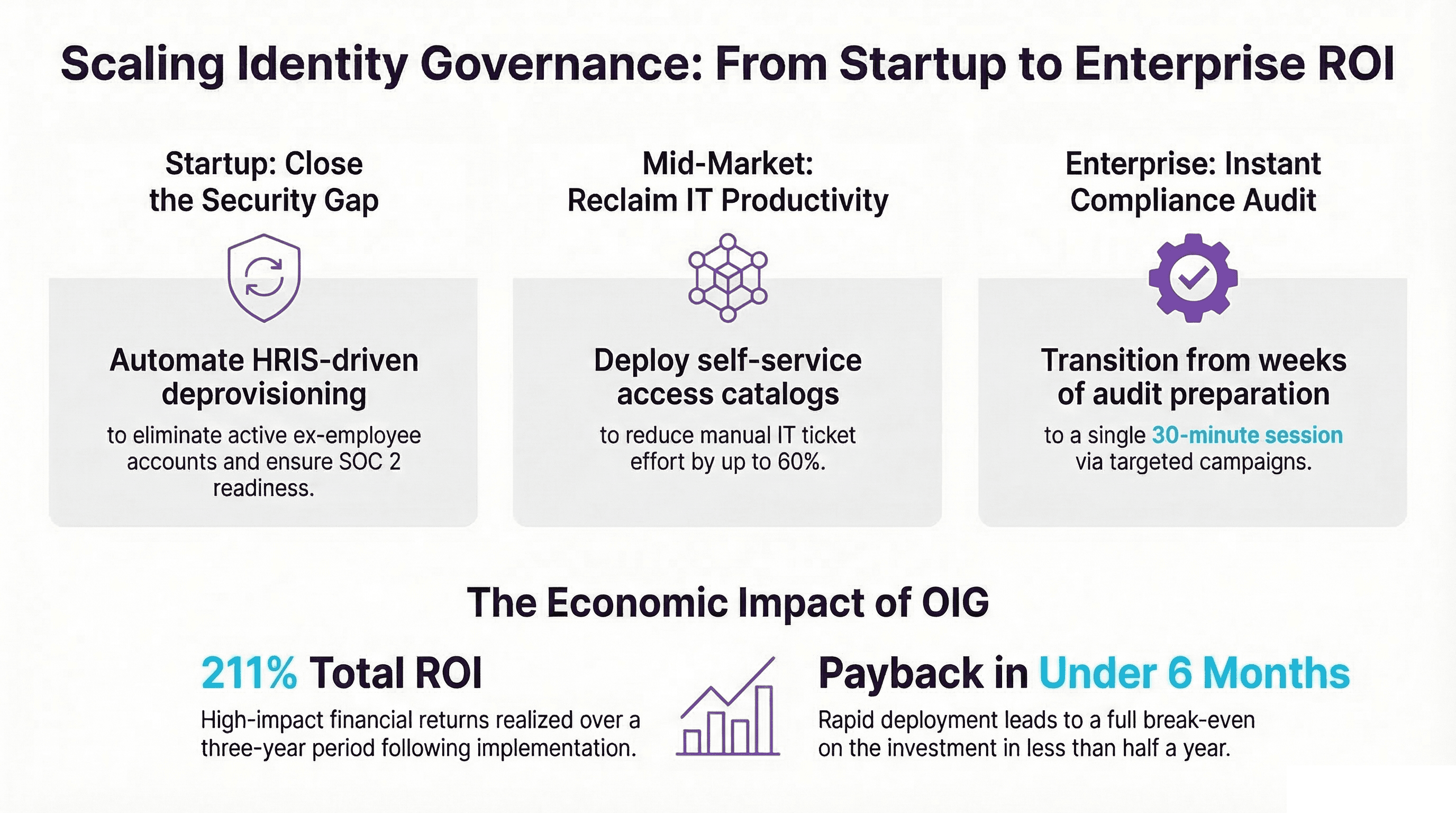
OIG fixes the structural problem. Automated deprovisioning from your HRIS means access gets revoked when someone leaves, not when someone remembers. Certification campaigns give you a reviewable, timestamped audit trail. Access requests create a documented approval record for every entitlement granted.
Getting through SOC 2 Type II is significantly more straightforward when you can show an automated, repeatable governance process rather than "we email managers once a quarter and hope for the best."
Mid-Market: When Manual Processes Start Breaking
Mid-market is where I see the most friction. The company has grown past the point where informal processes work, but hasn't fully committed to the tooling that makes governance scalable.
The symptoms are recognizable: IT is drowning in access request tickets. Onboarding a new employee takes days because every application has a different process. Access reviews are handled manually by HR or IT, who often don't actually understand what the entitlements mean. Delayed onboarding, over-provisioned accounts, security gaps from manual offboarding — these are the direct consequences of managing identity across disconnected systems without a unified data layer.
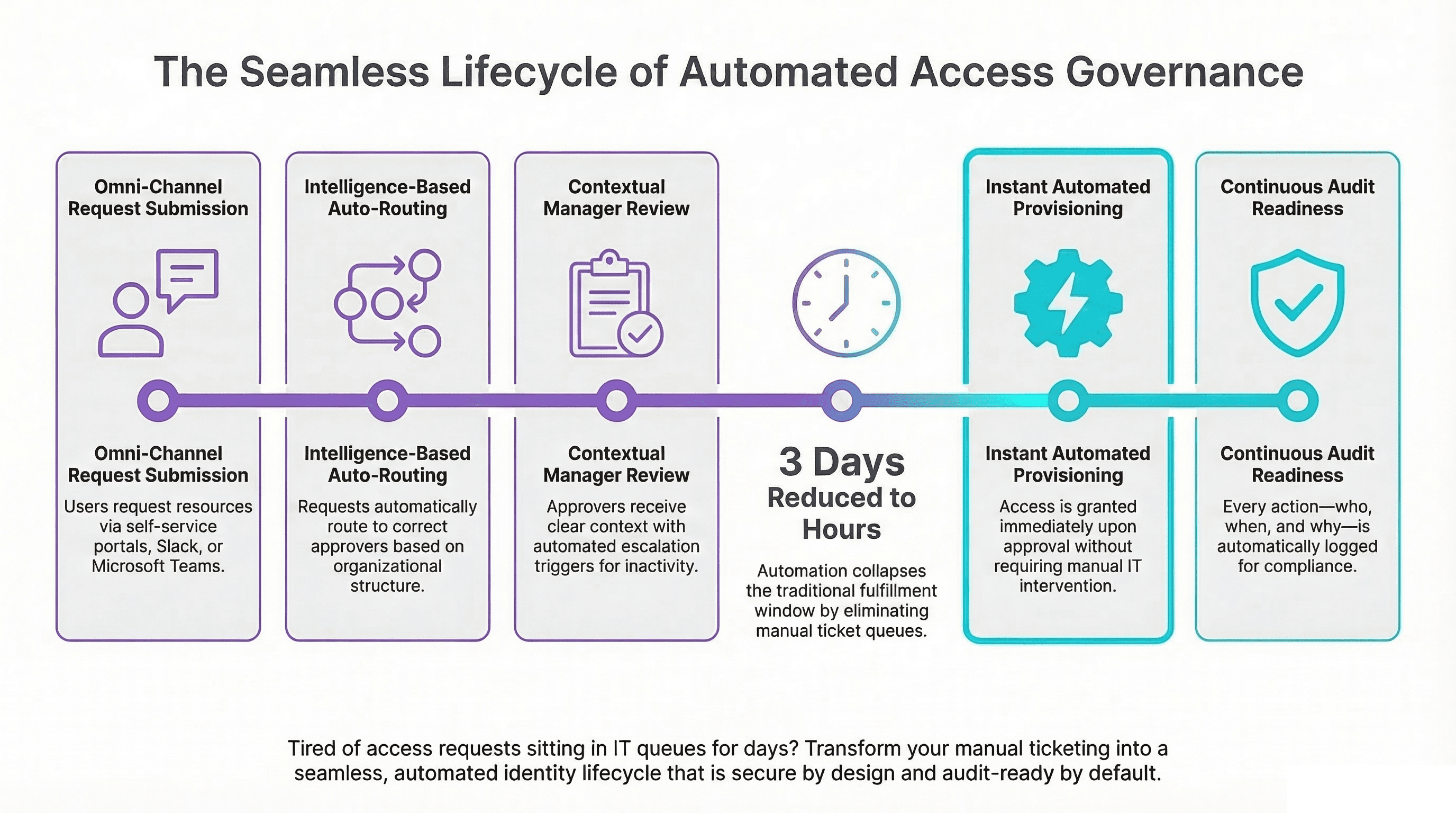
OIG's access request workflows change the day-to-day significantly. Users self-serve through a catalog of available resources. Approval flows route to the right people automatically. The whole process is logged and auditable. What used to take three days per request becomes same-day, and your IT team stops being a help desk for access tickets.
 Click to zoom
In practice, mid-market teams that implement Okta Identity Governance consistently reclaim significant IT capacity. The access request queue shrinks, onboarding stops being a multi-day coordination exercise, and the governance overhead that used to fall on IT or HR gets distributed to the people who actually own the resources.
Enterprise: Compliance at Scale
At enterprise scale, the governance problem isn't awareness — it's execution. Everyone knows access reviews need to happen. Everyone knows least privilege matters. The challenge is running it consistently across hundreds of applications, thousands of users, and multiple regulatory frameworks simultaneously.
OIG handles this through targeted campaign management. Instead of broad quarterly sweeps that take weeks and produce low-quality responses, you run scoped campaigns: just the finance team's access to financial systems for SOX, just external users for your annual vendor review, just privileged accounts for a security-triggered review.
Resource owners get clear, actionable review tasks. Automated reminders handle non-responders. Revocations trigger automatically when access is denied — no manual follow-up, no ticket required.
The compliance coverage is built in: SOC 2, SOX, PCI DSS. And the audit trail is always current — not reconstructed before an audit, but maintained continuously as part of normal operations.
One outcome Okta documented: an organization reduced audit preparation from several weeks down to a single 30-minute session with zero follow-ups. That's not a marginal efficiency gain — that's a structural change in how compliance work gets done.
 Click to zoom
My Take
If you're already on Okta and access management is creating friction — onboarding takes too long, offboarding is unreliable, audits are stressful, or you don't have a clear picture of who has access to what — OIG is the natural next layer to add. You're not introducing a new platform, a new data sync, or a new integration to maintain. You're building on what's already there.
Governance that runs on the same data as your authentication isn't just more efficient. It's more accurate, more current, and more useful when something actually goes wrong.
If you want to go deeper on the lifecycle model that feeds into Okta Identity Governance, Joiner Mover Leaver (JML): The Identity Lifecycle Guide covers the full picture — from what JML actually means to how to measure whether it's working. If you're ready to implement OIG in your environment, our IAM Architecture & Governance Advisory is how we scope and deliver those engagements.